
Prepper Pedagogy
Prepper Pedagogy explores the ways in which contemporary civil society is enmeshed with militarized violence. By examining practices of pre-emption, civil defence and emergency preparedness, the project delineates the home front of the battlefield as manifested through the domestic politics of surveillance, enclosure and territorialisation. Prepper pedagogy describes the discourses and practices that instruct pre-emptive ways of knowing and being in relation to perceived threats of persistent social disorder and/or uncertainty. For example, national programs for emergency and disaster preparedness are civic practices that educate the citizenry to their state security function – uncertainty must be internalized, managed and neutralized for safety to be assured. The enmeshment of civilian, military and carceral logics and spaces is seen as normative and indeed, desirable. Prepper pedagogy can also describe how martial politics instruct individual responses to differently imagined threats – climate collapse, for instance, or germ apocalypse, or doomsday. Contemporary preppers or “survivalists” are maverick social formations often characterized by libertarian notions of self-reliance and alt-right politics. But there are also models of survival that move outside of and against the neo-liberal politics of nation building. The research, which involves several case studies and is evolving over time, explores how prepper pedagogies both perpetuate and resist the normative epistemological and ontological foundations and practices of the settler colonial state.
On August 16-18, 2022 our research team organized a two-day connections activity in partnership with The Diefenbunker Museum, and funded by a Social Science and Humanties Research Council Connection Grant. The event explored the history of Canadian Cold War preparedness infrastructures and the contemporary challenges of analyzing, interpreting, and communicating their significance. Attendees were drawn from respected institutes and organizations such as the Canadian War Museum, the municipal government of the Region of Waterloo, the Shingwauk Residential Schools Centre, and a variety of academic institutions, and included academics, researchers, artists and policy makers. We contributed materials exploring public safety in the Region of Waterloo during the Cold War, including the history of the nuclear bunker built in 1966 near Freeport. We hope to eventually produce a digital exhibition for this material in partnership with the Region of Waterloo Museums.
In June 2019, we were awarded a Social Sciences and Humanities Research Council Partnership Engage Grant for our research project Animating the Archive: Cold War Civil Defence and Public Pedagogy. In collaboration with our partner organization – the Diefenbunker: Canada’s Cold War Museum – the project shed light on an unexplored aspect of Canada’s Cold War history – civil defence education and its relationship to nation building. A strategy of Cold War defence familiar to many through the animated “duck and cover” television campaigns produced for the American public during the early 1950’s, civil defence education was also integral to the project of sovereignty in Canada. Now commonly referred to as emergency preparedness, programs for civil defence have experienced a recent resurgence as nations perceive new threats to national security, including those instantiated by climate change, cyberwarfare and terrorism.
In Canada, the history of civil defence and its resonances in contemporary practices of emergency preparedness has yet to be systematically documented and studied, particularly from an intersectional (Crenshaw, Nash) perspective. The proposed project aspires to meet this challenge by adopting a digital humanities approach to knowledge mobilization. The Diefenbunker Museum has been at the forefront of the preservation of Canada’s Cold War history since its founding as a non-profit organization in 1997. It currently occupies the site of the former Central Emergency Government Headquarters, a 75-foot underground bunker in Carp, ON meant to house government staff evacuated from Ottawa in the event of a catastrophic nuclear event. Drawing on the synergies of the partnership, our one of our innovative research outputs was a digital exhibition of Canadian Cold War propaganda posters which can be viewed here.
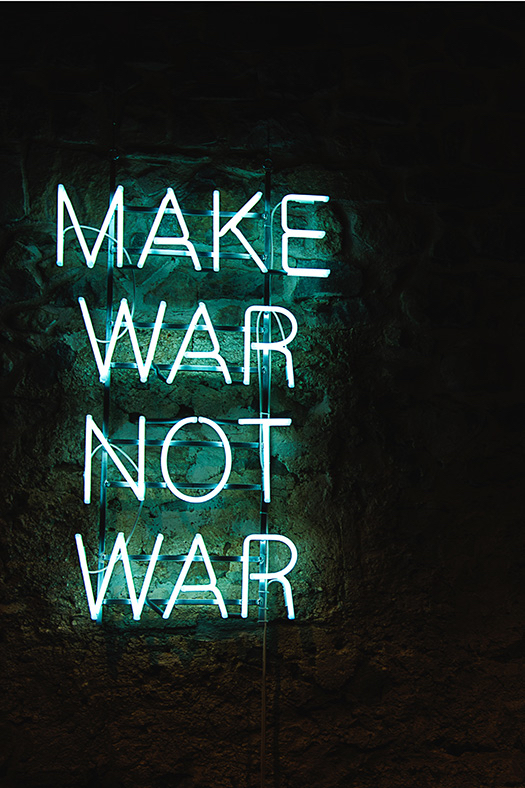
Anne-Julie Raccoursier. “Make War Not War”, 2015, néon.
Past Presentations:
Matthews, S. and C. Woodley, Nuclear Preparedness and Cold War Infrastructure: A Case Study in Waterloo Region, 33rd Canadian Military History Colloquium, May 26, 2022, Wilfrid Laurier University.
Matthews. S. “Are you ready?”: Apocalypse Camp, Prepper Pedagogies and Ontologies of Martial Preparedness. Paper presented at the International Convention of the International Studies Association, Las Vegas, Nevada (remotely attended), April 6, 2021.
Matthews, S. What is the Time of War Preparedness? Discourses of Public Safety and Radicalization in Canada. War Preparedness Workshop, Götenburg, Sweden, funded by the ISA (International Studies Association), February 6-7, 2020.
Matthews, S. The Emergence of Emergency: Pedagogies of Preparedness. Critical Perspectives on Pandemics, Religion and Public Life 20th Anniversary, Department of Religion and Culture, Wilfrid Laurier University, November 27, 2020.
Matthews, S. Researching War Preparedness: Challenges, Theories and Interdisciplinary Possibilities as part of the International Convention of the International Studies Association, Toronto, ON, March 27, 2019.
Matthews, S. and I.I. Diaz. Prepper Pedagogy, The ‘Fruit Machine’ and Queer Resistances. 2019 NORA Conference on Border Regimes, Territorial Discourses and Feminist Politics, May 22-24 at the University of Reykjavik.
Publications:
Garrett, H. J. and S. Matthews. “Prepper Pedagogies, Specters of Doomsday and Social Studies Education”. p. 167-177 In: Varga, B.A. (Ed.). 2025. Hauntological Social Studies: More-Than-Human Deviances, Imbrications, and Proliferations of Possibility. Springer Publishing.
Matthews, S. The Emergence of Emergency. TOPIA: Canadian Journal of Cultural Studies. Vol. 41, Fall 2020. p.61-69.
Matthews, S., and J. Anstett. 2015. Finding Diefenbunker: Canadian Nationalism and Cold War Memory. Waterloo: Wilfrid Laurier University Press. CMTS Dialogues Series. 41pages. E-book. ASIN: B0114XZIB2.
Project Publication 1: Intervention – “Prepper Pedagogy: Civil Defense, Emergency Preparedness, and Nation Building”